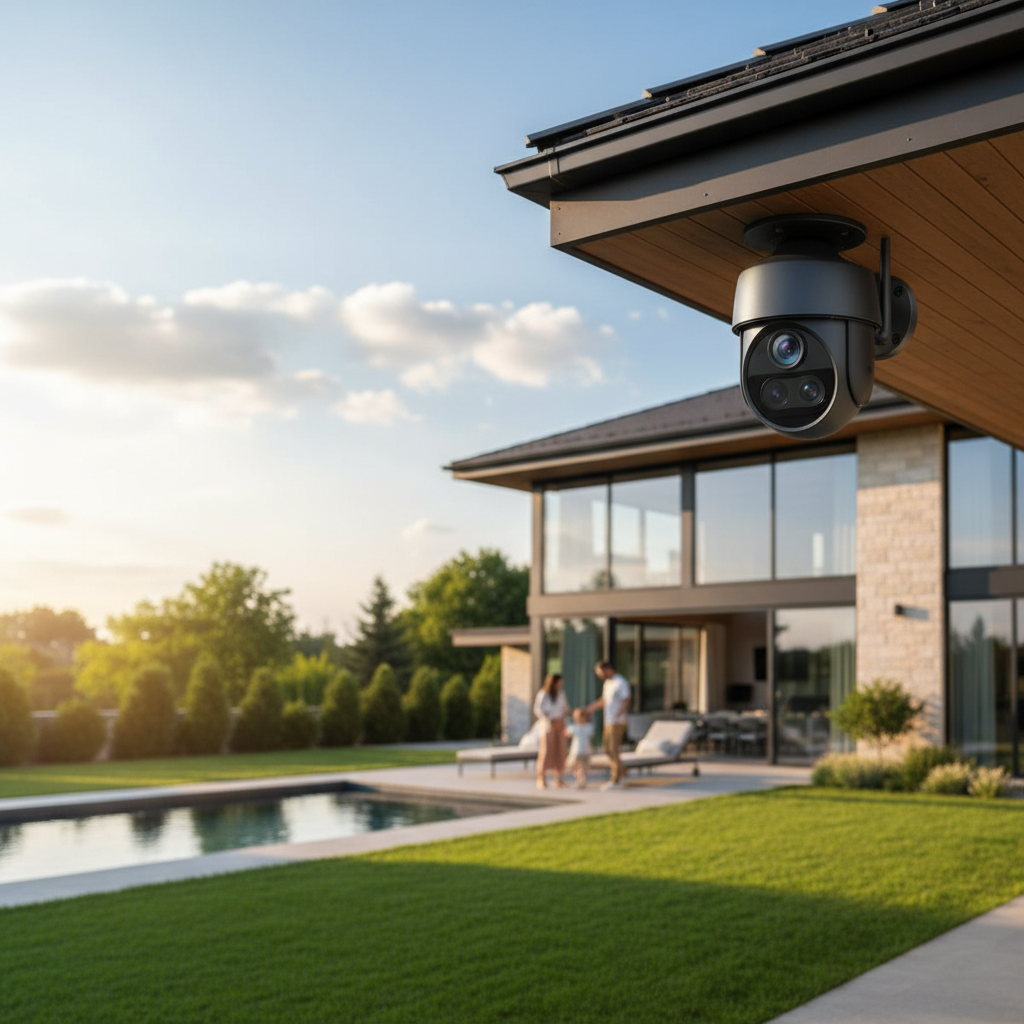
In the modern quest for home security, two devices frequently stand out: the outdoor security camera and the smart doorbell. Both promise peace of mind and enhanced surveillance, yet they serve distinct purposes and excel in different scenarios. Understanding their unique strengths and limitations is key to making the right choice for your property. This comprehensive guide delves into their features, benefits, and ideal applications, helping you determine the true winner for your specific security needs.
Securing Your Perimeter: The Core of Outdoor Surveillance
Protecting your home and loved ones begins with effective outdoor surveillance. Outdoor cameras and smart doorbells are frontline defenders, deterring potential intruders and capturing crucial evidence when incidents occur. While a robust outdoor camera offers extensive coverage of your property’s perimeter, monitoring entry points, yards, and driveways with high-definition clarity, a smart doorbell provides a focused view of your primary entryway, enabling direct interaction with visitors and monitoring package deliveries. Each device plays a critical role, contributing to a layered security approach that safeguards your valuable assets and ensures a sense of safety around the clock.
Understanding the Tech: A Look at Device Types and Capabilities
Delving into the technology behind these devices reveals their specialized functions. Outdoor cameras are designed for broad area monitoring, typically coming in various forms and offering advanced features.
Outdoor security cameras are available in several common types. Bullet cameras are prominent and easily identifiable, acting as a visible deterrent with their cylindrical shape. Dome cameras are more discreet, often mounted on ceilings or overhangs, making their direction of view harder to ascertain. For expansive areas, Pan-Tilt-Zoom (PTZ) cameras offer unparalleled flexibility, allowing users to remotely adjust the camera’s angle and zoom in on specific details. These cameras generally boast higher resolutions, ranging from 4MP to 12MP, ensuring crystal-clear images that can capture fine details like license plates or facial features from a distance. Their robust construction often includes advanced weatherproofing, making them resilient against harsh elements, and superior night vision capabilities, frequently incorporating color night vision for enhanced clarity after dark.
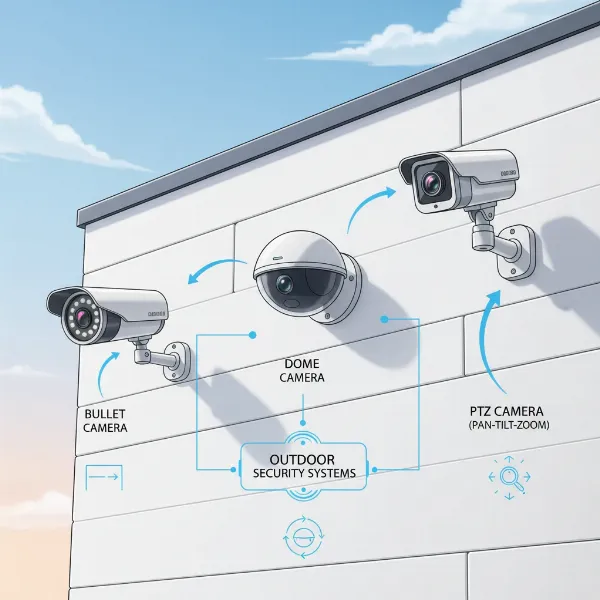 Overview of various outdoor security camera types, showcasing bullet, dome, and PTZ designs.
Smart doorbells, on the other hand, are specifically tailored for entryway security and interaction. Integrated directly into or beside your front door, they typically feature resolutions around 1080p, with some advanced models reaching 2K (4MP). Their primary capabilities include real-time motion detection, instant alerts to your smartphone, and crucial two-way audio, allowing you to speak directly with visitors or delivery personnel whether you’re home or away. Many also include specialized features like package detection, distinguishing between a person and a dropped parcel. While their field of view is generally narrower than that of outdoor cameras, focusing intensely on the immediate doorstep area, their ease of installation and direct communication features make them an indispensable tool for managing front-door activity.
Comparative Analysis: Outdoor Camera vs. Smart Doorbell Features
Choosing between an outdoor camera and a smart doorbell hinges on understanding their distinct feature sets and how they align with your specific security objectives. While both provide visual surveillance, their application scenarios and technical capabilities vary significantly.
| Feature | Outdoor Security Camera | Smart Doorbell |
|---|---|---|
| Primary Use | Comprehensive property surveillance, wide-area monitoring | Front-door monitoring, visitor interaction, package alerts |
| Field of View | Wide (180-360 degrees), can cover large areas, zoom often available | Narrower (100-120 degrees), focused on doorstep |
| Video Resolution | High (4MP to 12MP), superior detail capture | Standard (1080p to 2K/4MP), clear for close-up |
| Night Vision | Advanced, often with color night vision, longer range | Standard infrared, clear in low light, shorter range |
| Installation | More complex, may require wiring, strategic mounting for coverage | Easier, DIY-friendly, often uses existing doorbell wiring or battery |
| Cost | Generally higher, especially for advanced models | Generally lower for basic models, good entry point |
| Discretion | Can be mounted discreetly in corners or hidden spots | Highly visible at eye level, primary point of interaction |
| Audio | Two-way audio common, but less emphasized than video | Two-way audio is a core feature for direct communication |
| AI Features | Object detection, vehicle tracking, facial recognition | Person detection, package detection, facial recognition |
| Storage | Local (NVR/DVR, SD card) and cloud options | Cloud subscription (common), local SD card (some models) |
Choosing Your Champion: Key Criteria for Home Security
Selecting the ideal security device requires a thoughtful assessment of your specific needs, property layout, and desired level of interaction. It’s not simply about picking the most expensive option but rather the one that best addresses your unique security challenges.
First, assess your needs and property layout. Consider the areas you want to monitor. Do you have a large backyard, a long driveway, or side gates that need surveillance? An outdoor camera with a wide field of view or PTZ capabilities would be more suitable for extensive coverage. If your primary concern is managing who comes to your front door, interacting with visitors, and monitoring package deliveries, a smart doorbell is precisely engineered for that purpose. For apartment dwellers, a smart doorbell often provides sufficient front-door security without requiring extensive installation.
Next, evaluate technical specifications. For critical areas, prioritize higher video resolution (4MP and above) for outdoor cameras to ensure you capture clear, identifiable footage. Night vision quality is also paramount; look for features like color night vision or enhanced infrared ranges. When considering storage, decide between local options (SD card, NVR/DVR) for privacy and no recurring fees, or cloud storage for convenience and remote access, often requiring a subscription. Power options vary, with wired cameras offering continuous power and battery-powered devices providing installation flexibility.
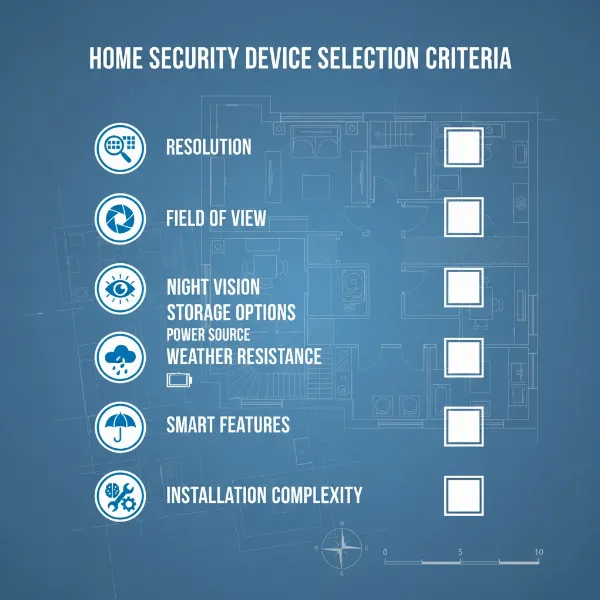 Key criteria for selecting home security devices, showing a checklist with various factors.
Finally, consider smart features and integration. Many devices now offer advanced AI-powered capabilities such as person detection, facial recognition, and package alerts, which can significantly reduce false notifications. Two-way audio is a standard for smart doorbells and increasingly common in outdoor cameras, allowing for direct communication or even deterring intruders. Ensure the device integrates seamlessly with your existing smart home ecosystem, whether it’s Google Home, Amazon Alexa, or Apple HomeKit, for a unified and convenient security experience. The ease of setting up motion zones and notification preferences should also be a factor, tailoring alerts to your specific concerns.
Top Security Picks: What Makes a Device Stand Out
When considering top-tier outdoor cameras and smart doorbells, it’s less about specific brand names and more about the advanced features and reliability they offer. For comprehensive outdoor surveillance, the best outdoor cameras distinguish themselves with high-resolution imaging, often 4K or higher, ensuring unparalleled detail. Look for models with superior night vision, including starlight sensors or color night vision, which can provide clear, identifiable footage even in complete darkness. Robust weatherproofing (IP65/IP66 ratings) is essential for durability in diverse climates. Advanced models frequently include AI-powered analytics for accurate person, vehicle, and even animal detection, minimizing false alarms. Features like PTZ functionality (pan-tilt-zoom) and optical zoom allow for dynamic monitoring and closer inspection of suspicious activity across large areas.
For smart doorbells, the leading devices prioritize crisp two-way audio for clear communication with visitors, alongside fast and reliable motion detection to capture events promptly. HD video quality (1080p or 2K) with a wide, head-to-toe field of view is crucial for identifying individuals and monitoring package deliveries effectively. Pre-roll recording can capture a few seconds of footage before a motion event, providing critical context. Many top smart doorbells also offer customizable motion zones and package detection alerts, enhancing their utility for front-door security. Integrated cloud storage options are often part of the package, providing secure backup of recorded events, alongside options for local storage via an SD card or a hub. Ultimately, the “top pick” is the device that combines these advanced features with user-friendly controls and seamless smart home integration.
Setting Up and Maintaining Your Security Devices
Proper installation and consistent maintenance are crucial for maximizing the effectiveness and longevity of both outdoor cameras and smart doorbells. A well-installed system operates optimally, while regular upkeep prevents issues and ensures continuous protection.
For installation, first identify the best placement. For outdoor cameras, this means strategic positioning to cover critical entry points, vulnerable areas, and blind spots, ensuring an unobstructed view. Consider the camera’s field of view and any potential glare from lighting. Wired cameras typically offer more stable connections and continuous power but require routing cables, which can be more complex. Wireless cameras provide greater flexibility in placement but rely on Wi-Fi stability and battery life (if applicable). Smart doorbells are usually straightforward, replacing an existing doorbell or mounting near the front door. Ensure they are at an optimal height for capturing faces and packages, and that they receive a strong Wi-Fi signal. Always test the device’s functionality and connectivity immediately after installation.
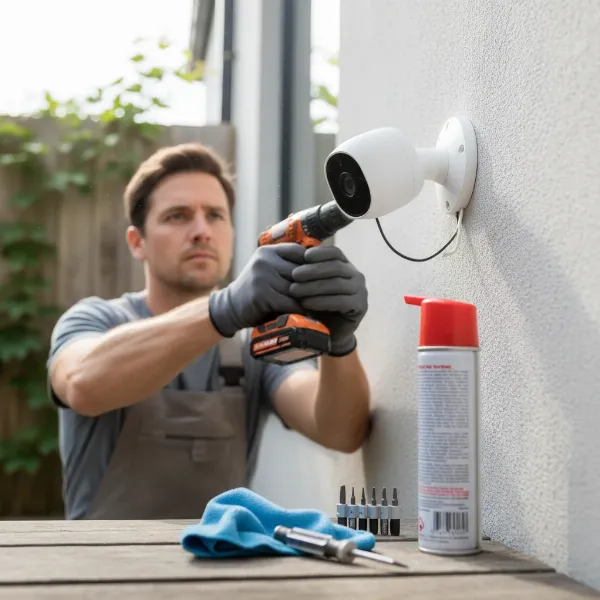 A homeowner installing an outdoor security camera, with maintenance tools in the foreground.
Maintenance for both devices primarily involves keeping lenses clean to ensure clear footage. Use a soft, damp cloth to wipe away dust, dirt, or water spots regularly. For battery-powered devices, monitor battery levels and recharge or replace them as needed. Regularly check the connections (wired or wireless) to ensure they are secure and functioning properly. Software and firmware updates are vital for security patches, new features, and improved performance; always keep your devices up-to-date. Finally, periodically review your recorded footage and settings to confirm the devices are capturing what you intend and that motion detection zones are correctly configured. By following these steps, you can ensure your outdoor cameras and smart doorbells provide reliable security for years to come.
The Definitive Buying Guide: Equipping Your Home with Confidence
Navigating the array of outdoor security devices can be overwhelming, but a clear strategy ensures you equip your home with the perfect solution. The definitive buying guide focuses on matching technology with your real-world needs.
Begin by establishing your budget. Security devices range widely in price, from entry-level smart doorbells to advanced, multi-camera outdoor systems. Knowing your financial limits helps narrow down options, but remember that investing in quality can save money and provide greater peace of mind in the long run. Consider not just the upfront cost, but also potential subscription fees for cloud storage or advanced features.
Next, prioritize your specific security concerns. Are you worried about package theft, general perimeter surveillance, or monitoring a specific area like a detached garage? Your primary concern will dictate whether an outdoor camera or a smart doorbell is the leading contender, or if a combination of both is the most effective approach. For instance, a smart doorbell is invaluable for package alerts and visitor interaction, while an outdoor camera excels at watching over a wide yard.
 A person researching security devices on a tablet, surrounded by informational charts and product features.
Evaluate key features and specifications against your needs. Resolution, field of view, night vision capabilities, and weather resistance are paramount for outdoor placement. For smart doorbells, two-way audio quality, motion detection accuracy, and integration with other smart home systems are crucial. Always consider the ease of installation—whether you prefer a DIY battery-powered device or are comfortable with more complex wired setups. Finally, research brand reputation and warranty policies. Reliable brands often provide better customer support and more frequent software updates, ensuring your investment remains secure and functional for years.
Conclusion
Choosing between an outdoor camera and a smart doorbell, or deciding on the ideal combination, ultimately hinges on a precise understanding of your home’s unique security landscape and your personal priorities. While the outdoor camera stands as the champion for comprehensive, wide-area surveillance with its superior resolution, expansive field of view, and robust weather resistance, the smart doorbell undeniably wins when it comes to focused front-door interaction, package monitoring, and direct communication with visitors. Both are indispensable tools in the modern homeowner’s arsenal, each excelling in its designated domain to provide enhanced security and peace of mind.
Are you looking to blanket your property with vigilant eyes, or is your primary concern centered on who approaches your threshold? Understanding these distinctions will empower you to make an informed decision, creating a tailored security system that truly guards what matters most.
Frequently Asked Questions
Which offers better video quality for identifying intruders, an outdoor camera or a smart doorbell?
|
Our Picks for the Best Outdoor camera in 2026
As an Amazon Associate I earn from qualifying purchases.
|
||
| Num | Product | Action |
|---|---|---|
| 1 | Security Cameras Wireless Outdoor 355° Pan Rotating 2K Color Night Vision Cameras for Home Security WiFi Battery Outdoor Camera Motion Detection 2-Way Talk IP65 Spotlight Siren SD/Cloud Storage 2 Pack |

|
| 2 | GMK Security Cameras Wireless Outdoor 4 Pack, 2K Battery Powered Cameras for Home Security, Color Night Vision, Motion Detection, 2-Way Talk, IP65 Waterproof, Remote Access, Cloud/SD Storage |
|
| 3 | eufy Security 3K Dual Camera, SoloCam S340, Solar Security Cameras Wireless Outdoor, Cameras for Home Security, 360°Coverage, Pan & Tilt, No Blind Spots, No Monthly Fee, HomeBase S380 Compatible |
|
| 4 | Blink Outdoor 4 – Wireless smart security camera, two-year battery life, 1080p HD day and infrared night live view, two-way talk. Sync Module Core included – 3 camera system |
|
| 5 | aosu Security Cameras Outdoor Wireless, 4 Cam-Kit, No Subscription Required, Solar-Powered, Home Security Cameras System with 360° Pan & Tilt, Auto Tracking, 2K Color Night Vision, Easy Setup |
|
| 6 | All-new Blink Video Doorbell + Outdoor 4 – Wireless smart security cameras, head-to-toe HD view, two-year battery life. Sync Module Core included – 2 camera system + Video Doorbell |
|
| 7 | 2026 Upgraded 2K Security Cameras Wireless Outdoor, Free Cloud Storage, 1-6 Months Battery Life, Waterproof, 2-Way Talk, AI Motion Detection Spotlight Siren Alarm Cameras for Home Security |
|
| 8 | Ring Outdoor Cam Plus, Battery (newest model), Home or business security, Wide-Angle 2K Video with Ring Vision, Low-Light Sight for full-color night vision, Mount-Anywhere Versatility, Black |
|
| 9 | Ring Outdoor Cam (Stick Up Cam), Weather-resistant home or business security camera, outdoor ready, Live View, Color Night Vision, Two-Way Talk, motion alerts, Works with Alexa, White |
|
| 10 | WYZE Cam v4 (Latest Model), 2.5K AI Security Camera, Indoor/Outdoor Cameras for Home Security, Baby Monitor & Pet Camera, Vibrant Color Night Vision, No Subscription Required, Free Expert Help |
|
Outdoor cameras generally offer superior video quality, with resolutions often ranging from 4MP to 12MP, compared to the typical 1080p or 2K (4MP) of smart doorbells. This higher resolution, combined with advanced night vision and zoom capabilities, makes outdoor cameras more effective at capturing detailed footage for intruder identification across wider areas.
Can a smart doorbell replace an outdoor security camera for general surveillance?
A smart doorbell cannot fully replace an outdoor security camera for general surveillance. Smart doorbells are specifically designed for the front entryway, offering a narrower field of view. Outdoor cameras, conversely, provide broader coverage, can be strategically placed around the entire property, and often feature wider angles and higher resolution for comprehensive monitoring.
What are the main advantages of a smart doorbell over an outdoor camera?
The main advantages of a smart doorbell include its specific focus on front-door interaction, integrated two-way audio for direct communication with visitors, easy package delivery monitoring, and typically simpler DIY installation. It’s ideal for managing visitor access and deterring package theft right at your primary entryway.
Is installation more complex for outdoor cameras compared to smart doorbells?
Generally, outdoor cameras can have more complex installation requirements, often necessitating wiring for power and data, and strategic mounting at higher or less accessible points for optimal coverage. Smart doorbells are typically easier to install, often using existing doorbell wiring or battery power, making them more DIY-friendly.
Do both devices offer similar motion detection and alert features?
While both outdoor cameras and smart doorbells offer motion detection and send alerts, their capabilities can differ. Smart doorbells excel at detecting activity directly at the front door, often with specific features for package detection. Outdoor cameras often provide more advanced, customizable motion zones and AI detection for a wider range of objects across larger areas.
How important is weather resistance for outdoor security devices?
Weather resistance is critically important for any outdoor security device. Look for IP (Ingress Protection) ratings like IP65 or IP66, which indicate protection against dust and water jets, ensuring the device can withstand rain, snow, and extreme temperatures without compromising functionality or durability.
Should I get both an outdoor camera and a smart doorbell for optimal home security?
For optimal home security, combining both an outdoor camera and a smart doorbell is often the most effective strategy. A smart doorbell secures your main entry point, while outdoor cameras cover wider areas, blind spots, and additional access points, creating a comprehensive, multi-layered surveillance system around your property.